See the system
Version the whole AI application and release only when the relevant engineering and evaluation gates pass.
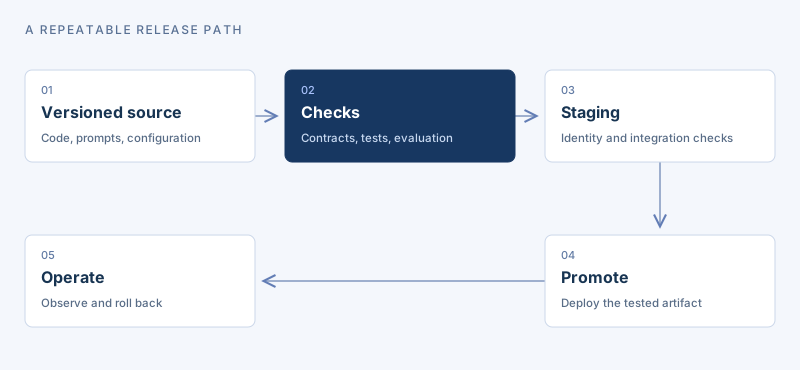
Define the release unit
An AI release includes more than source code. Prompt templates, model configuration, dependencies, tool contracts, retrieval settings, and evaluation data can all change behavior. Record their versions together.
A release manifest links these components to the tested artifact. Avoid rebuilding from an unpinned branch after approval. The code deployed should be the code reviewed and evaluated, with environment differences explicit.
Layer checks by cost and signal
Run fast deterministic tests on routine changes. Add integration and managed-platform checks where the affected boundary requires them. Expensive live-model evaluations should have explicit triggers and budgets, not run accidentally for every trivial edit.
Use fixtures for reproducible failure tests, and record which checks used a live provider. A passing mock adapter test does not demonstrate that the real provider contract still works.
Deploy resources from versioned configuration
Declarative Automation Bundles, formerly Asset Bundles, let Databricks project resources and source configuration participate in source control and deployment workflows. Learn the validate/deploy/run lifecycle using current official documentation.
Keep environment-specific identities and parameters explicit. Never commit secrets. Validate against the target environment and handle existing resources deliberately rather than overwriting an unknown workspace.
Promote with evidence
Promotion should depend on code checks, evaluation results, permissions, operational readiness, and the applicable release policy. An aggregate quality improvement cannot hide a critical security regression. Record who owns the go/no-go decision.
A canary limits exposure while observing real behavior, but requires a defined cohort, signals, and stop condition. Randomly sending a fraction of traffic to a candidate without a response plan is not a complete rollout strategy.
Rehearse rollback and compatibility
Rollback can fail if the old application cannot read a new schema or if an irreversible tool action already occurred. Plan compatibility and data migrations separately from swapping code versions.
Rehearse restoring the previous tested configuration and verifying the critical user path. Preserve evidence of the failed release for diagnosis while protecting sensitive data. Document which effects rollback can and cannot reverse.
Worked scenario
A prompt change starts proposing unsupported ticket states. Schema tests catch the invalid category locally; held-out task evaluation finds additional behavior regressions. The release remains blocked. Fix and reevaluate the same candidate artifacts instead of editing the deployed prompt manually.
Practical assignment
- Run the bundled deterministic checks.
- Create a release manifest.
- Design CI stages with explicit live-test budgets.
- Introduce a deliberate contract regression and verify failure.
- Document a deployment/promotion path.
- Rehearse a local rollback and state which managed steps remain unverified.
What to submit
Submit the artifacts named above, a short explanation of your decisions, and evidence of the checks you performed. Distinguish measured results from estimates and designs from executed integrations.
| Review dimension | Submission evidence |
|---|---|
| Correctness | Show the expected behavior and a meaningful counterexample. |
| Reproducibility | State setup, inputs, versions, and what was actually executed. |
| Delivery judgment | Explain the client impact, alternative, and unresolved assumption. |
| Operational boundary | Identify permissions, failure behavior, and any resource cleanup. |
Knowledge check
Answer guide
- Code, prompts, configuration, dependencies, and evaluation versions. Many independently changing components affect application behavior.
- Behavior against the mock’s contract. Live integrations require their own appropriate verification.
- No. Completed business actions may require separate compensating procedures.
References & next step
Platform examples are environment-dependent. Start with the official documentation in the reference library and verify the exact cloud, region, privileges, and versions you use.
Open the official reference library
Editorial edition: 5 October 2026. The local reference lab is executed locally; this course does not claim a live Databricks deployment.