See the system
Build a small useful prototype, gather realistic feedback, and decide what must change before a pilot.
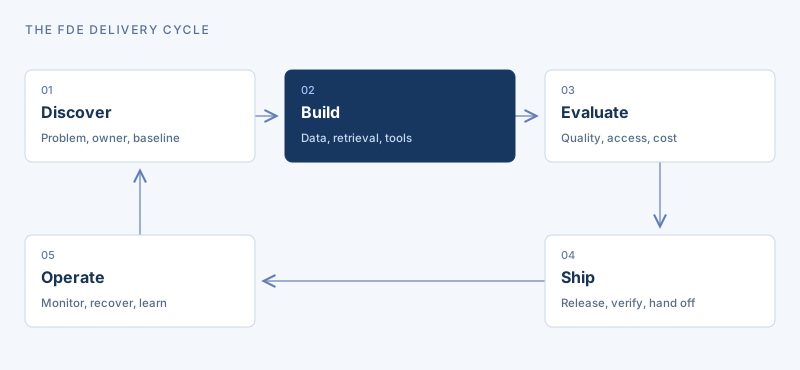
Learn the domain’s decision structure
Domain expertise includes vocabulary, workflow, exceptions, authority, and consequences. A maintenance assistant, procurement helper, and support copilot may use similar retrieval code but require different evidence and review boundaries.
Ask which decisions are reversible, which require expertise, and which source is authoritative. Use synthetic data for learning and obtain qualified domain review before making operational claims in high-stakes settings.
Time-box around an evidence goal
A prototype should answer a specific uncertainty: can we retrieve the needed evidence, can users verify the result, or can the integration support the workflow? Build the smallest slice that tests it.
State what is simulated and what is real. A polished interface backed by a fixed response can test presentation, but it cannot establish retrieval quality or production integration. Label the boundary so reviewers interpret the demo correctly.
Observe actual user tasks
Give users a concrete task and watch how they work. Ask them to explain confusion, verify an answer, and recover from an error. Leading questions such as “Was that helpful?” produce weaker evidence than observing task completion.
Record task outcomes, review effort, and recurring misunderstandings. Keep sample limitations visible. A few enthusiastic comments are useful feedback, but not proof of organization-wide adoption.
Compare against the current workflow
Measure the baseline and assisted workflow under comparable conditions. Counterbalance task order when learning effects matter. Record correctness and rework alongside time, because faster incorrect work is not an improvement.
Report small-study results cautiously and distinguish synthetic exercises from operational pilots. Explain what remains uncertain and which next experiment would reduce that uncertainty.
Make the pilot decision explicit
A pilot needs owners, real access arrangements, representative data, support, success criteria, and stop conditions. The prototype may need major changes before it can meet those requirements.
Use a decision record: proceed, revise, defer, or stop, with evidence and dependencies. Avoid moving into production simply because the demonstration was well received. Reusable assets should preserve tested patterns, not preserve known prototype shortcuts.
Worked scenario
A manufacturing maintenance prototype retrieves the right manual but users cannot tell which equipment revision it applies to. The next iteration should establish equipment-to-document version mapping and expert review. Adding a more autonomous agent would not address the observed failure.
Practical assignment
- Select a support, procurement, retail, or maintenance scenario.
- Define one uncertainty to test.
- Build a clearly labeled prototype slice.
- Run a structured task review with a peer.
- Compare results with a baseline.
- Submit a pilot decision and unresolved dependencies.
What to submit
Submit the artifacts named above, a short explanation of your decisions, and evidence of the checks you performed. Distinguish measured results from estimates and designs from executed integrations.
| Review dimension | Submission evidence |
|---|---|
| Correctness | Show the expected behavior and a meaningful counterexample. |
| Reproducibility | State setup, inputs, versions, and what was actually executed. |
| Delivery judgment | Explain the client impact, alternative, and unresolved assumption. |
| Operational boundary | Identify permissions, failure behavior, and any resource cleanup. |
Knowledge check
Answer guide
- A specific uncertainty. A narrow evidence goal guides scope and interpretation.
- Only the behavior it actually simulates. Mocked behavior must be labeled so its evidence is not overstated.
- Observed task completion and recovery. Concrete tasks reveal friction and errors.
References & next step
Platform examples are environment-dependent. Start with the official documentation in the reference library and verify the exact cloud, region, privileges, and versions you use.
Open the official reference library
Editorial edition: 5 October 2026. The local reference lab is executed locally; this course does not claim a live Databricks deployment.