See the system
Detect degraded behavior, recover deliberately, and communicate clearly when an AI application fails.
Define meaningful service indicators
Choose indicators tied to user outcomes: successful completed tasks, evidence freshness, latency, unavailable dependencies, and blocked unsafe actions. Raw request volume alone says little about usefulness.
Service objectives need a defined window and workload. Separate an application failure from an appropriate refusal of an unauthorized request. A denied attack should not automatically be counted as a product defect.
Create actionable alerts
An alert should identify a condition worth human attention and provide a first diagnostic step. Combine sustained symptoms with relevant context to reduce noise. Differentiate a single transient retry from a prolonged loss of service.
Link the alert to a runbook. Include safe identifiers, environment, recent changes, and relevant dashboards. Avoid putting customer text in notifications simply because it is available.
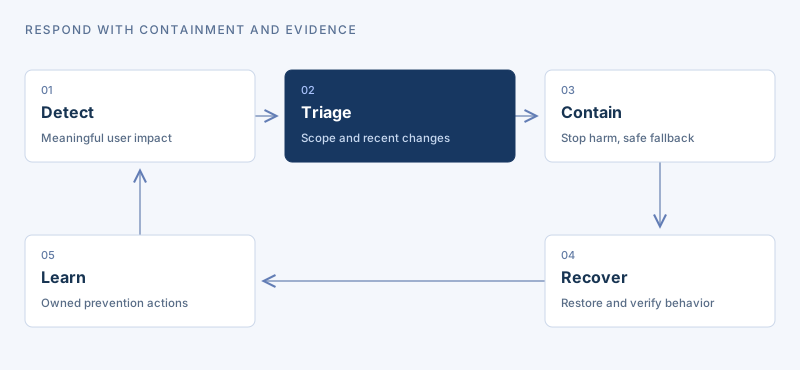
Triage and contain
During an incident, first establish impact and contain harmful behavior. Stop unsafe writes, disable a failing feature, or use a known safe fallback when appropriate. Preserve evidence and maintain a clear timeline.
Assign an incident lead and communication owner. Avoid multiple people making conflicting production changes. Communicate what is known, what is uncertain, the user impact, and the next update time without speculative promises.
Recover and validate
Restore the service through a tested rollback, dependency recovery, or repaired data path. Verify user-facing behavior and access controls before declaring recovery. Check queued work and uncertain writes rather than assuming they resolved themselves.
Fallback behavior must have its own boundaries. Returning an old cached policy may be worse than temporarily refusing to answer. Choose fallbacks according to data sensitivity, freshness, and the task’s consequences.
Learn from the incident
A postmortem explains the sequence, contributing factors, detection gaps, response, and follow-up actions. Avoid reducing the explanation to a person’s mistake when system design made the failure easy.
Assign owners and due dates to a small number of concrete improvements. Convert important failures into tests or monitoring. Review whether the original assumptions about workload, permissions, or dependencies still hold.
Worked scenario
An assistant continues answering from an index that missed a policy revocation. Contain by disabling affected answers or enforcing a safe freshness gate, then repair synchronization and invalidate caches. Recovery includes proving the revoked source is absent from future retrieval and citations.
Practical assignment
- Rehearse model outage, stale index, and denied tool action.
- Record a timeline and user impact.
- Choose containment and safe fallback.
- Verify recovery with explicit checks.
- Draft stakeholder communication.
- Create a postmortem and add a regression case.
What to submit
Submit the artifacts named above, a short explanation of your decisions, and evidence of the checks you performed. Distinguish measured results from estimates and designs from executed integrations.
| Review dimension | Submission evidence |
|---|---|
| Correctness | Show the expected behavior and a meaningful counterexample. |
| Reproducibility | State setup, inputs, versions, and what was actually executed. |
| Delivery judgment | Explain the client impact, alternative, and unresolved assumption. |
| Operational boundary | Identify permissions, failure behavior, and any resource cleanup. |
Knowledge check
Answer guide
- Contain the unsafe behavior and assess impact. Containment reduces further harm while diagnosis continues.
- No. Freshness and task consequences determine whether fallback is acceptable.
- A causal explanation and owned improvements. Learning requires concrete prevention or detection changes.
References & next step
Platform examples are environment-dependent. Start with the official documentation in the reference library and verify the exact cloud, region, privileges, and versions you use.
Open the official reference library
Editorial edition: 5 October 2026. The local reference lab is executed locally; this course does not claim a live Databricks deployment.