See the system
Keep technical work aligned with decisions, dependencies, scope, and the people who will operate it.
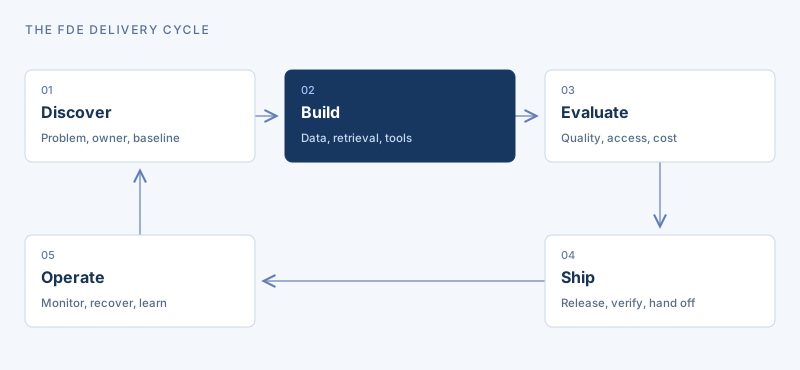
Plan around outcomes and dependencies
Break work into small slices that demonstrate an outcome. Include integration, review, security, and operational work in estimates rather than treating them as free extras after the demo.
Identify dependencies and their owners early. A blocked API permission can dominate the schedule even when coding is straightforward. Make uncertainty visible with assumptions and ranges instead of false precision.
Run working sessions that make decisions
A useful workshop has a clear question, the right participants, necessary pre-reading, and an expected output. Show a concrete workflow or example so disagreements become specific.
Record the decision, reasoning, owner, and unresolved items. Do not mistake attendance for agreement. Confirm how a decision affects acceptance criteria and who will verify it.
Handle scope changes transparently
A requested change can alter data, permissions, integration, evaluation, support, and schedule. Assess those effects before accepting it into the current delivery. Small UI changes can conceal significant operational behavior changes.
Offer choices: replace lower-priority scope, extend delivery, narrow the change, or defer it. Explain consequences in terms the client cares about, while preserving the quality gates needed for responsible release.
Support distributed collaboration
Asynchronous work needs context that survives a handoff: current state, decisions, reproduction steps, blockers, and next action. A message saying “it failed” wastes the next team’s time.
Use code review to explain reasoning and share standards. Mentor by asking for the evidence behind a choice and demonstrating a debugging approach. Clear interfaces and ownership reduce overlap and conflicting work across time zones.
Communicate for the audience
Executives need workflow impact, decisions, risk, and what happens next. Engineers need architecture, contracts, evidence, and operational details. Both need honesty about uncertainty and incomplete verification.
A good demo follows a user task, shows evidence, and includes a meaningful failure or boundary. Do not hide the approval step because it makes the demo less dramatic; it is part of the operating model.
Worked scenario
The sponsor asks for autonomous closure before the pilot. Explain that this adds action authorization, approval policy, integration semantics, rollback limitations, and new evaluation. Offer to keep staff-reviewed drafts for the current pilot and schedule an evidence-based decision on closure afterward.
Practical assignment
- Create an outcome-based backlog.
- Run a source-of-truth workshop simulation.
- Assess one late scope change.
- Write an asynchronous engineering handoff.
- Review a peer’s architecture decision.
- Present a concise status update with blockers and decisions needed.
What to submit
Submit the artifacts named above, a short explanation of your decisions, and evidence of the checks you performed. Distinguish measured results from estimates and designs from executed integrations.
| Review dimension | Submission evidence |
|---|---|
| Correctness | Show the expected behavior and a meaningful counterexample. |
| Reproducibility | State setup, inputs, versions, and what was actually executed. |
| Delivery judgment | Explain the client impact, alternative, and unresolved assumption. |
| Operational boundary | Identify permissions, failure behavior, and any resource cleanup. |
Knowledge check
Answer guide
- A demonstrable outcome with acceptance evidence. Observable outputs make progress reviewable.
- State, decisions, blockers, reproduction, and next action. The next person needs enough context to continue accurately.
- State the assumption, impact, and next validation step. Visible uncertainty supports better decisions.
References & next step
Platform examples are environment-dependent. Start with the official documentation in the reference library and verify the exact cloud, region, privileges, and versions you use.
Open the official reference library
Editorial edition: 5 October 2026. The local reference lab is executed locally; this course does not claim a live Databricks deployment.