See the system
Present verifiable evidence of your work and explain your decisions under unfamiliar constraints.
Build a claim-to-evidence portfolio
A strong case study explains the problem, your role, constraints, design, results, and limitations. Link claims to artifacts: tests, diagrams, evaluation reports, code, and demos. Distinguish coursework, simulated clients, and employment experience.
Do not invent usage, revenue, or savings. An honest account of a failed approach and the evidence that changed your decision can demonstrate more judgment than an unsupported success story.
Practice coding and SQL reasoning
Interview exercises often test how you clarify requirements, handle edge cases, and explain tradeoffs. Start with a correct simple solution and meaningful examples. Use tests to expose uncertainty rather than writing a large framework before understanding the task.
For SQL, state grain and join cardinality. For Python, clarify invalid input, mutation, error behavior, and complexity when relevant. Narrate decisions clearly without treating every thought as equally important.
Defend an enterprise AI architecture
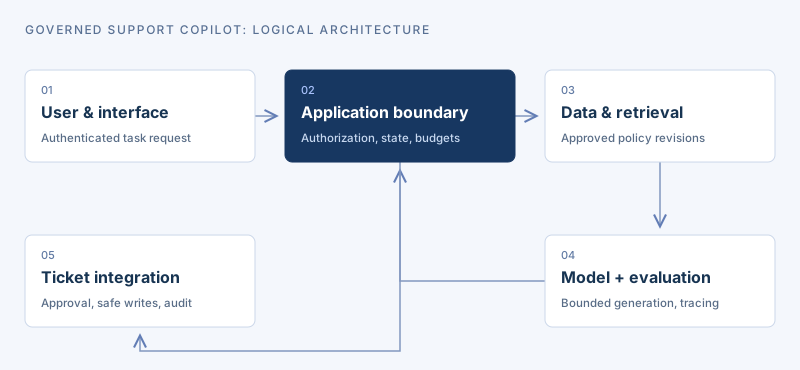
Start system design with users, workload, data boundaries, actions, and success criteria. Then discuss retrieval, tools, evaluation, deployment, cost, and operations. Tie each component to a requirement.
Expect changed constraints: lower budget, restricted network, stale data, new department, or revoked permissions. Explain which assumptions break and how the design changes. Avoid reaching for multi-agent complexity before establishing need.
Tell delivery stories with evidence
Structure a behavioral example around situation, responsibility, action, result, and reflection. Name your actual contribution and the team’s contribution separately. If the result is a learning exercise, say so.
Useful stories include resolving stakeholder disagreement, debugging a production-like failure, narrowing an oversized request, and mentoring a peer. Explain what you would change next time based on evidence.
Make the handoff reusable
Package a project so another engineer can understand and reproduce it. Include setup, data provenance, tests, configuration, architecture, known limitations, and cleanup. Reusable assets should have clear boundaries and ownership.
Prepare separate executive and technical demos. Be ready to show a denied request and a recovery path, not only success. A portfolio is strongest when the reviewer can inspect the evidence independently.
Worked scenario
A candidate says “I improved support productivity by 40%” after timing five synthetic questions. Rewrite the claim: “In a five-case synthetic exercise, the assisted workflow reduced measured completion time under these conditions; operational impact remains untested.” Then show the data and explain the next validation step.
Practical assignment
- Package code, architecture, tests, evaluation, and runbook.
- Create a claim-to-evidence index.
- Complete one Python and one SQL exercise.
- Defend the architecture under a changed constraint.
- Record executive and technical demo outlines.
- Review the narrative for accurate scope and attribution.
What to submit
Submit the artifacts named above, a short explanation of your decisions, and evidence of the checks you performed. Distinguish measured results from estimates and designs from executed integrations.
| Review dimension | Submission evidence |
|---|---|
| Correctness | Show the expected behavior and a meaningful counterexample. |
| Reproducibility | State setup, inputs, versions, and what was actually executed. |
| Delivery judgment | Explain the client impact, alternative, and unresolved assumption. |
| Operational boundary | Identify permissions, failure behavior, and any resource cleanup. |
Knowledge check
Answer guide
- As assessed project work with its actual scope. Honest scope makes evidence credible.
- Users, workload, constraints, and success criteria. Architecture follows the problem and operating constraints.
- Inspectable evidence and clear limitations. Reviewers should be able to trace claims to artifacts.
References & next step
Platform examples are environment-dependent. Start with the official documentation in the reference library and verify the exact cloud, region, privileges, and versions you use.
Open the official reference library
Editorial edition: 5 October 2026. The local reference lab is executed locally; this course does not claim a live Databricks deployment.